Why Can’t College Students Do Middle School Math?
1 in 12 incoming UCSD freshmen don’t know middle school math, and the remedial math course was too advanced, so UCSD had to create a remedial remedial math course covering elementary and middle school math, and a quarter of the students placing into it had a perfect 4.0 GPA in their high school math courses, which included calculus or precalculus for nearly half of those remedial remedial students. And it's not just a UCSD problem -- the disease has spread so far that even Harvard had to had to add remedial support to their entry-level calculus courses to deal with a "lack of foundational algebra skills among students".
Want to get notified about new posts? Join the mailing list and follow on X/Twitter.
So let me get this straight:
- 1 in 12 incoming UCSD freshmen don’t know middle school math,
- and the remedial math course was too advanced,
- so UCSD had to create a remedial remedial math course covering elementary and middle school math,
- and a quarter of the students placing into it had a perfect 4.0 GPA in their high school math courses,
- which included calculus or precalculus for nearly half of those remedial remedial students.
That sounds so ridiculous, like something you’d read in The Onion, but it’s unfortunately real.
Here are some direct quotes from the UCSD report:
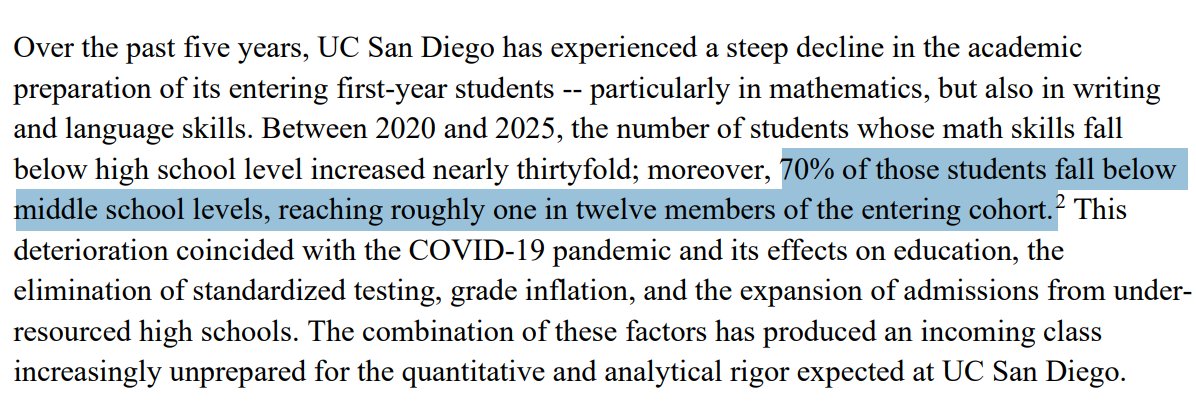
- "Between 2020 and 2025, the number of students whose math skills fall below high school level increased nearly thirtyfold; moreover, 70% of those students fall below middle school levels, reaching roughly one in twelve members of the entering cohort."
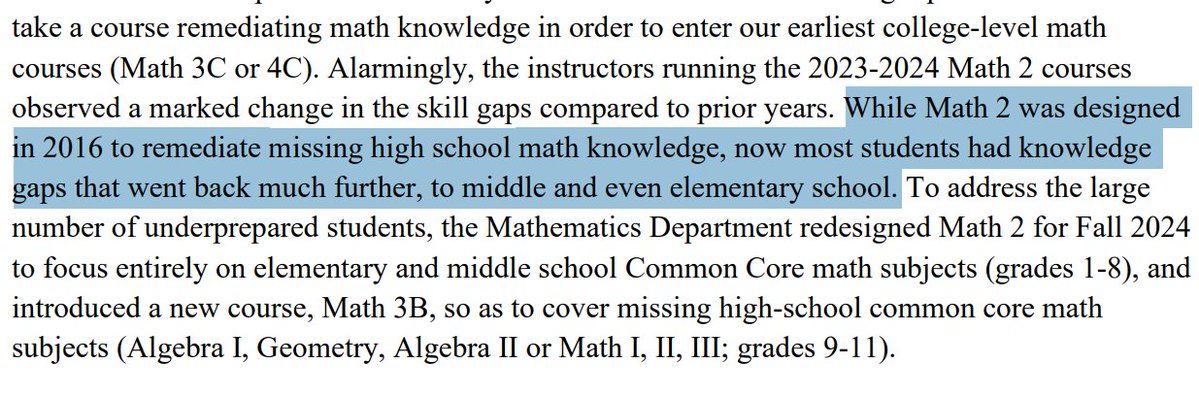
"While Math 2 was designed in 2016 to remediate missing high school math knowledge, now most students had knowledge gaps that went back much further, to middle and even elementary school. To address the large number of underprepared students, the Mathematics Department redesigned Math 2 for Fall 2024 to focus entirely on elementary and middle school Common Core math subjects (grades 1-8), and introduced a new course, Math 3B, so as to cover missing high-school common core math subjects (Algebra I, Geometry, Algebra II or Math I, II, III; grades 9-11)."
"Few, if any, students who place into Math 2 have successfully completed an engineering degree."
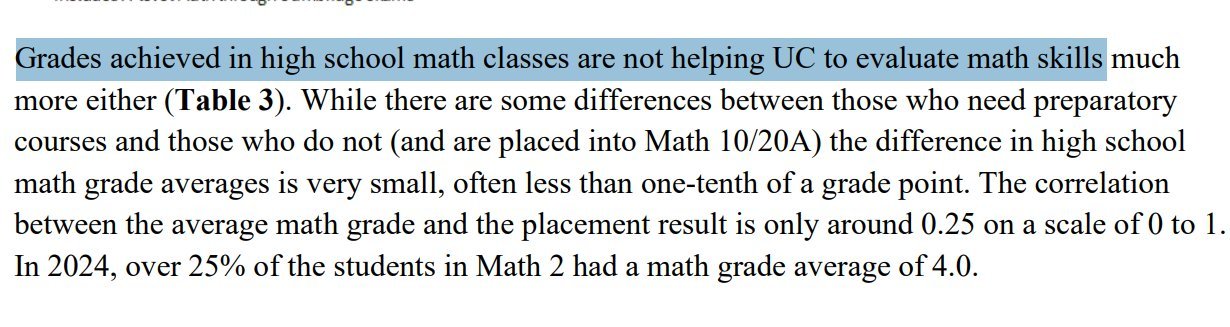
"high school math grades are only very weakly linked to students’ actual math preparation."
"The correlation between the average math grade and the placement result is only around 0.25 on a scale of 0 to 1. In 2024, over 25% of the students in Math 2 had a math grade average of 4.0."
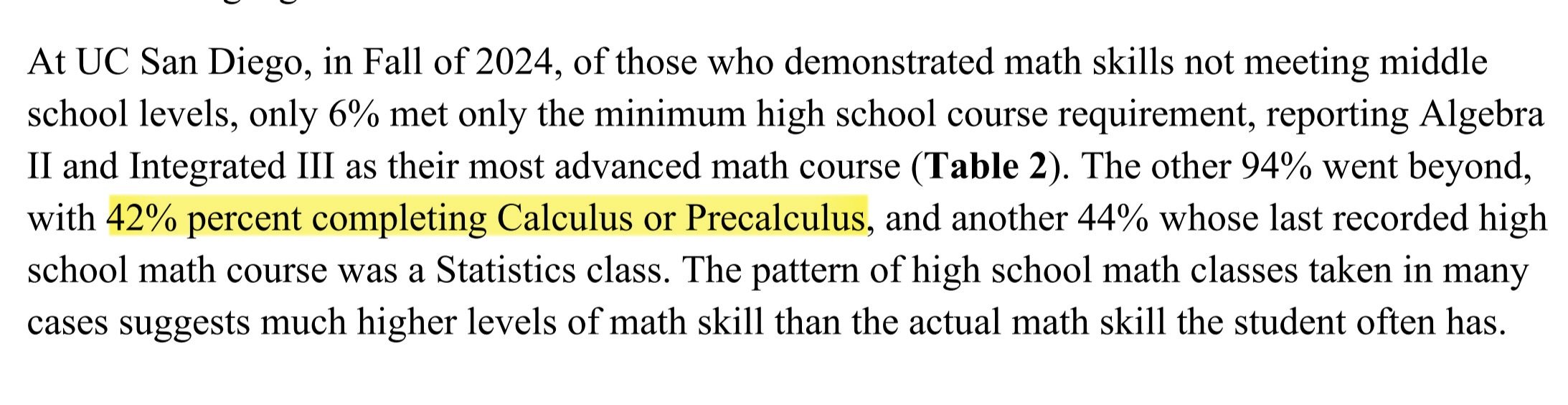
"of those who demonstrated math skills not meeting middle school levels, 94% went beyond [the minimum high school course requirement], with 42% percent completing Calculus or Precalculus."
"The pattern of high school math classes taken in many cases suggests much higher levels of math skill than the actual math skill the student often has."
"In fact, for more than two decades the Mathematics Department has found that out of all available student data, the single best predictor for math placement has been the SAT (math section) score, with the ACT score being an equally good predictor."
Some of these quotes seem so unbelievable that it feels worthwhile to include screenshots as well:
If you thought grade inflation was bad, this brings it to a whole new level.
By the way, this isn’t just a UCSD problem.
The disease has spread so far that even Harvard does remedial math these days.
Harvard, the most prestigious university in the USA and maybe even the world, had to add remedial support to their entry-level calculus courses last year to deal with a “lack of foundational algebra skills among students”.
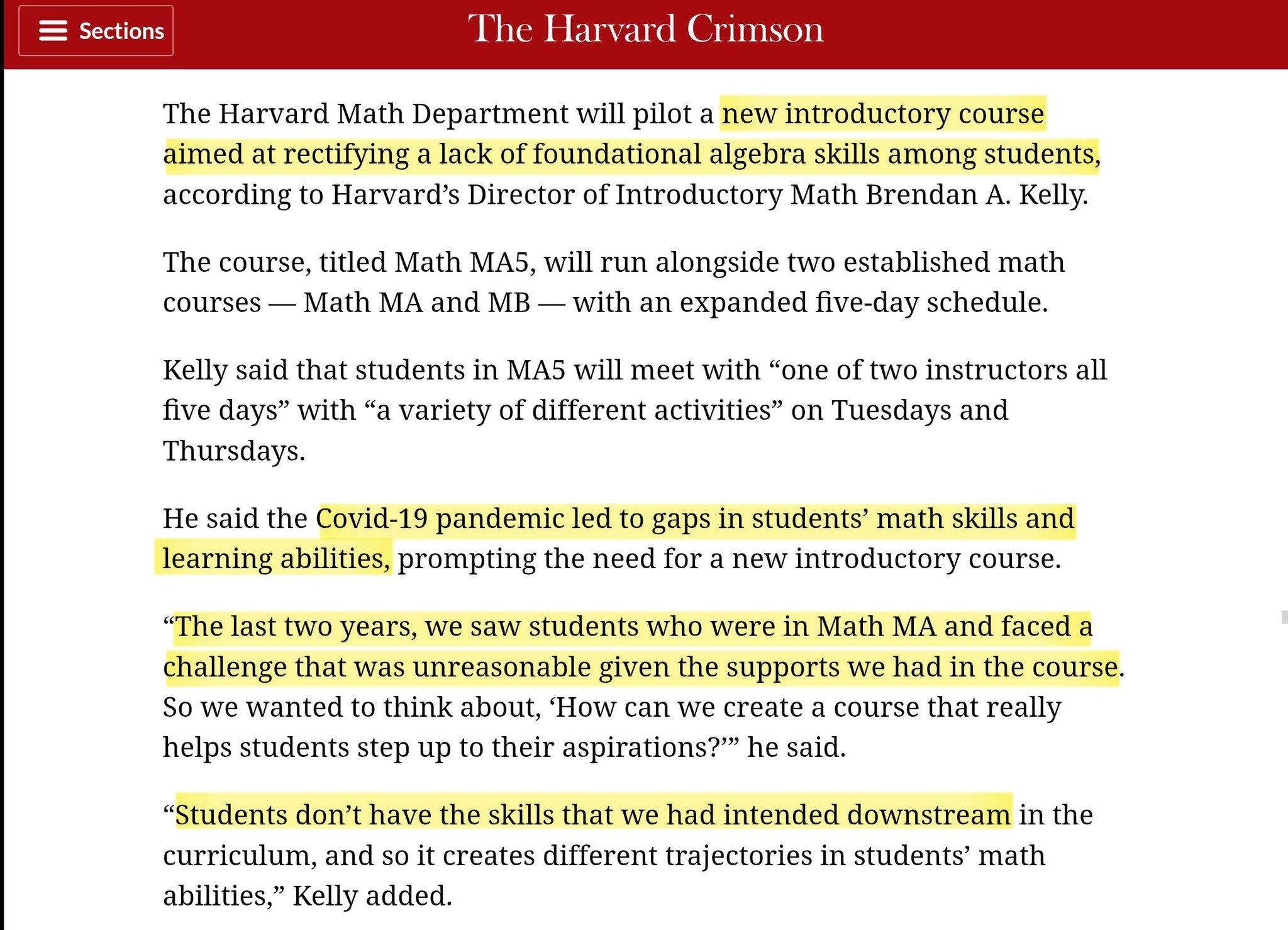
Why does Harvard report a “lack of foundational algebra skills among students”? Why can’t ~10% of UCSD freshmen do middle school math – basically, anything above arithmetic with fractions?
It’s easy to point a finger at pandemic learning loss, but that’s mainly just a scapegoat meant to hide a bigger factor: test-optional admissions.
For instance, Harvard didn’t require SAT/ACT scores from 2020–2024/25.
Basically:
- Oh no, the pandemic, there's a ton of learning loss
- Let's go test-optional, remove the last objective metric that is known to measure actual learning well, the last Jenga block
- Instead, we'll rely on high school grades, which are known to be inflated, especially during/after the pandemic
- Why do so many of these students lack foundational algebra skills?
- *points finger at pandemic*
Tons of students actually worked hard, took their learning seriously, and managed to keep their education on the rails during the pandemic.
But many universities chose not to consider that in admissions.
Predictably, it led to a train wreck, and now that it’s too big to ignore, many of them are pointing the finger at the pandemic.
Fortunately, Harvard reinstated testing requirements for fall 2025 admissions.
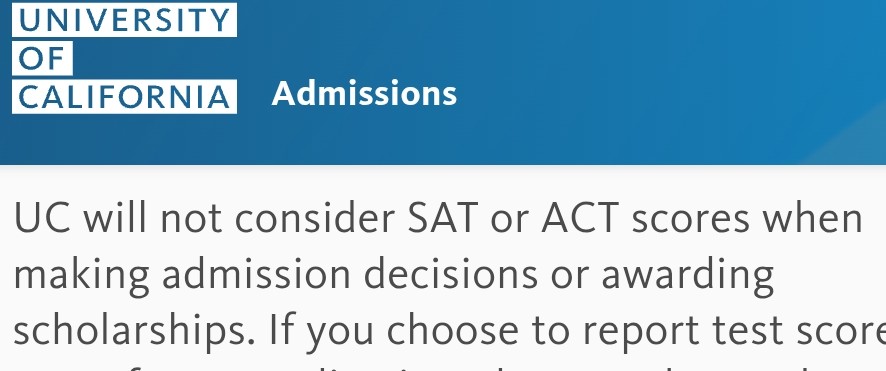
But many other universities still haven’t. For instance, the University of California campuses still don’t even consider SAT/ACT scores if you send them – not even when deciding who gets scholarships.
That is despite the fact that “for more than two decades the [UCSD] Mathematics Department has found that out of all available student data, the single best predictor for math placement has been the SAT (math section) score, with the ACT score being an equally good predictor.”
The natural follow-up question:
When you remove test scores from admissions, and grades are so inflated that they barely correlate with proficiency, what’s left to base admissions decisions on?
If the field of education is largely unconcerned with student performance, then what is it largely concerned with?
I got some firsthand signal on that when I completed my teaching credential from 2020-21 and attended numerous professional developments (PDs) from 2019-23.
It consisted mostly of DEI stuff including
- readings/essay on "hegemonic heteronormativity",
- anti-racism training,
- "sharing circle" training,
- even a presentation on the "gender unicorn", complete with an extraordinarily complex gender classification flowchart.
Forget the science of learning – even the most obvious practical skills that a teacher would need to exercise on a daily basis, such as managing a rowdy classroom, communicating with parents, holding students accountable for their work, and dealing with academic dishonesty, were not covered at all in teacher credentialing nor PD.
(Discussed further here: My Experience with Teacher Credentialing and Professional Development.)
The overall conclusion is that it’s imperative to require standardized test scores in college admissions and weight them heavily.
If you don’t, then you get the train wreck we’re currently seeing play out, where many admitted students have a low level of skill proficiency.
In other words: If you don’t select for skills, then you get many students who lack skills, at the expense of passing up many students who actually have them. Simple as that.
Granted, if you place heavy weight on a test, then there will be some “teaching to the test.”
But if it’s a good test (which the SAT/ACT are), then even teaching to the test will force students to develop a high level of true underlying skill.
You cannot score high on SAT/ACT math without having developed a relatively high level of mathematical proficiency.
That’s true even if you’re trying to “game” the SAT/ACT and learn as little as possible to get a high score.
In general, it’s important to focus on metrics that are fairly robust to Goodharting, i.e., whose direct pursuit actually produces a high level of performance.
Standardized tests are fairly robust.
High school grades are not.
(Yes, there is plenty of room to continue improving standardized tests, such as raising the ceiling of the highest skill level that the tests are capable of measuring.)
Further Discussion
How did we end up here? How did things get this bad and what can we do about it? I discussed further with Jason Roberts on Math Academy Podcast #6 Part 1: Why Can’t College Students Do Middle School Math?.
What we covered:
- A recent report from the University of California San Diego revealed that 1 in 12 incoming freshmen were not proficient in middle school math – basically, anything above arithmetic with fractions. Their existing remedial math course was too advanced for these students, so they had to design even lower remedial remedial math courses. Even crazier, over a quarter of these students had a perfect 4.0 GPA in their high school math courses.
- It’s not just UCSD. This is everywhere. A similar thing happened at Harvard, too, having to add remedial support to their entry-level calculus courses. It’s like that movie Olympus Has Fallen, except this time it’s Harvard. It’s a catastrophe.
- How did things get this bad? Teachers and administrators face relentless pressure to inflate grades, and during the pandemic many universities went test-optional, removing the only signal that reliably correlated with actual math readiness. That decision simultaneously elevated high school grades to the sole gatekeeping metric, intensifying incentives to inflate them.
- This has all coincided with the advent of LLMs, which make it increasingly easy for students to cheat. The result was predictable: grades became untethered from real competence, and multiple cohorts of students entered college without ever having to demonstrate foundational math skills.
- Teachers have to play both good cop and bad cop, and there is no avoiding the latter. If you refuse to play bad cop at all, you eventually end up playing it constantly. The best teachers are strict from the start and ease up later, once students understand that hard, honest work is non-negotiable.
Timestamps:
- 0:00 - Introduction
2:11 - Freshmen math collapse: 1 in 12 UCSD freshmen don't know middle school math
6:45 - Remedial remedial math: UCSD created remediation for remedial math
8:40 - Inflated grades: 25% of remedial-remedial students had perfect GPA in HS math
10:06 - Test-optional admissions removed the last objective metric
12:13 - Pandemic inflation: GPAs skyrocketed
14:37 - Removing tests pressures teachers to inflate grades
16:52 - Grade-grubbing: endless negotiating, complaining, accusations
19:01 - Then vs. now: parents, tests, accountability
27:38 - Crisis opportunism: "Never let an emergency go to waste"
29:33 - No tests = no knowledge requirements
33:28 - Elite collapse: Harvard has the same problem
36:31 - No enforcement means no standards
37:40 - LLM cheating is trivially easy
38:25 - Catching a cheater and turning him around
48:46 - Cheating is like taking mob money. Now you’re in, you’re never out.
50:41 - Assessments must be done in person
55:06 - LLM cheating is often obvious yet hard to prove
57:17 - How to prevent cheating on long papers
58:28 - Start hardcore, then lighten up gradually
1:01:37 - Good teachers play bad cop when needed
Follow-Up Questions
Q: What motivated you to get your teacher credential? I’ve also thought about getting my teacher credential, but decided against it for the same reasons as you’ve outlined. What made you decide to suffer through it?
A: I had to do a teaching credential in order to teach in Math Academy’s original school program, which operated in public schools (Pasadena Unified School District).
I.e., I worked as a public school teacher who exclusively taught Math Academy classes, and the district required all teachers to do credentials.
The credential itself was a complete waste of time, but I was so serious about Math Academy – even back then – that I was willing to put up with the suck and suffer through it (among other things).
In hindsight, I’m actually glad I did it because it gave me more firsthand experience with how bad things have gotten.
Some of these things sound so ridiculous and unbelievable that some people actually don’t believe it’s happening. But I can say “no, it’s real, I spent years right there in the train wreck.”
Want to get notified about new posts? Join the mailing list and follow on X/Twitter.