A Former Student Got Recruited By NASA With a Fighter Jet Ride as the Signing Bonus
Matteo won 1st place ($250,000) in the Regeneron Science Talent Search, got personally recruited by the head of NASA (with a fighter jet ride as a signing bonus), and published his results, solo-author, in The Astronomical Journal.
Want to get notified about new posts? Join the mailing list and follow on X/Twitter.
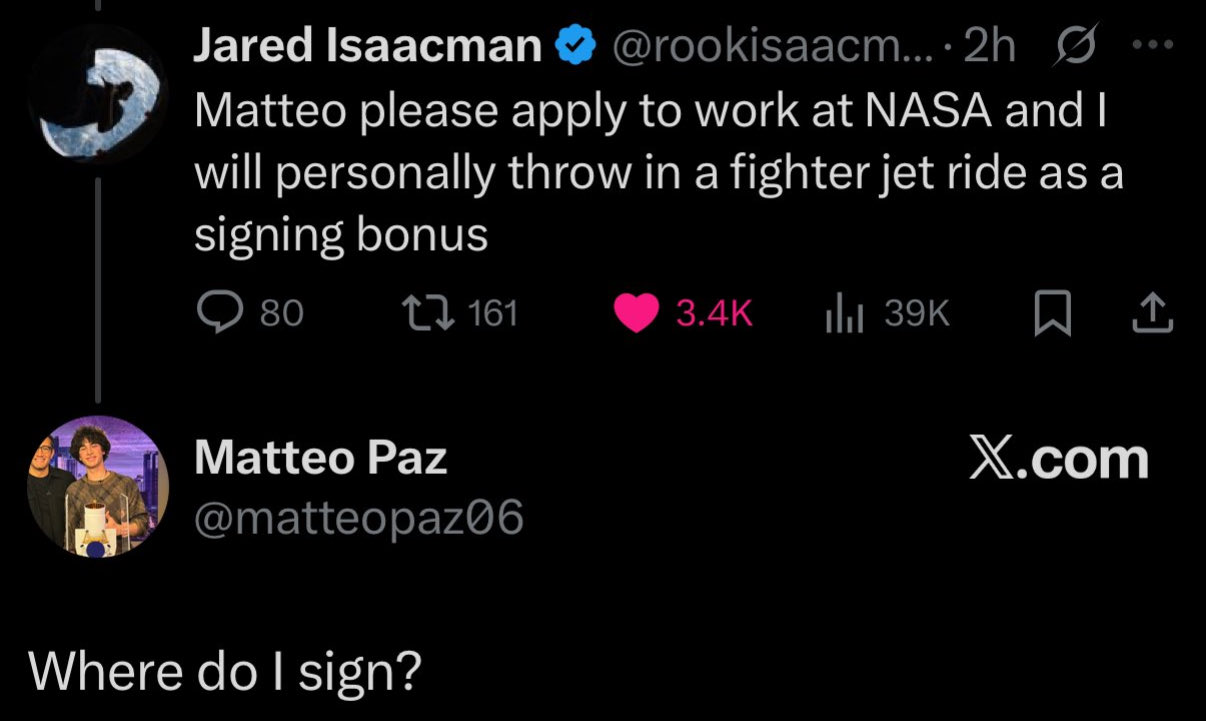
Can’t think of a better way to close out 2025 than seeing the head of NASA ask my former student Matteo Paz to apply, with a fighter jet ride as a signing bonus.
Matteo was one of my students in the Eurisko program, which, during its operation from 2020-23, was the most advanced high school math/CS sequence in the USA.
It culminated in high school students doing masters/PhD-level coursework (reproducing academic research papers in artificial intelligence, building everything from scratch in Python)
Matteo joined Eurisko as a 10th grader, during the last year it was offered, and worked hard to complete almost all 2-3 years’ worth of assignments in a single year. (Eurisko ended when I relocated; nobody else in the district had the requisite knowledge to teach it.)
This is exactly the position that we were trying to put students in with the Eurisko program – get them to a point of skill that they can capitalize on some math/coding-related opportunity and turn it into a chain reaction of fortunate events. And it’s been so great to witness some of these chain reactions get underway.
I’m so proud of Matteo for the many years of hard work he put in leading up to this point, and I’m so happy he’s getting to see it seriously pay off so early in life.
Matteo and other Math Academy students took their mathematical talent development seriously and learned
- all of high school math (Prealgebra / Algebra I / Geometry / Algebra II / Precalculus) in 6th and 7th grade,
- AP Calculus BC in 8th grade,
- and plenty of multivariable calculus / linear algebra / differential equations in 9th grade.
That’s why they were able to study serious quantitative coding in the Eurisko program – because they had solid and comprehensive math foundations.
Even within the Eurisko program, Matteo kept working hard to accelerate. He completed almost all 2-3 years’ worth of Eurisko assignments in a single year.
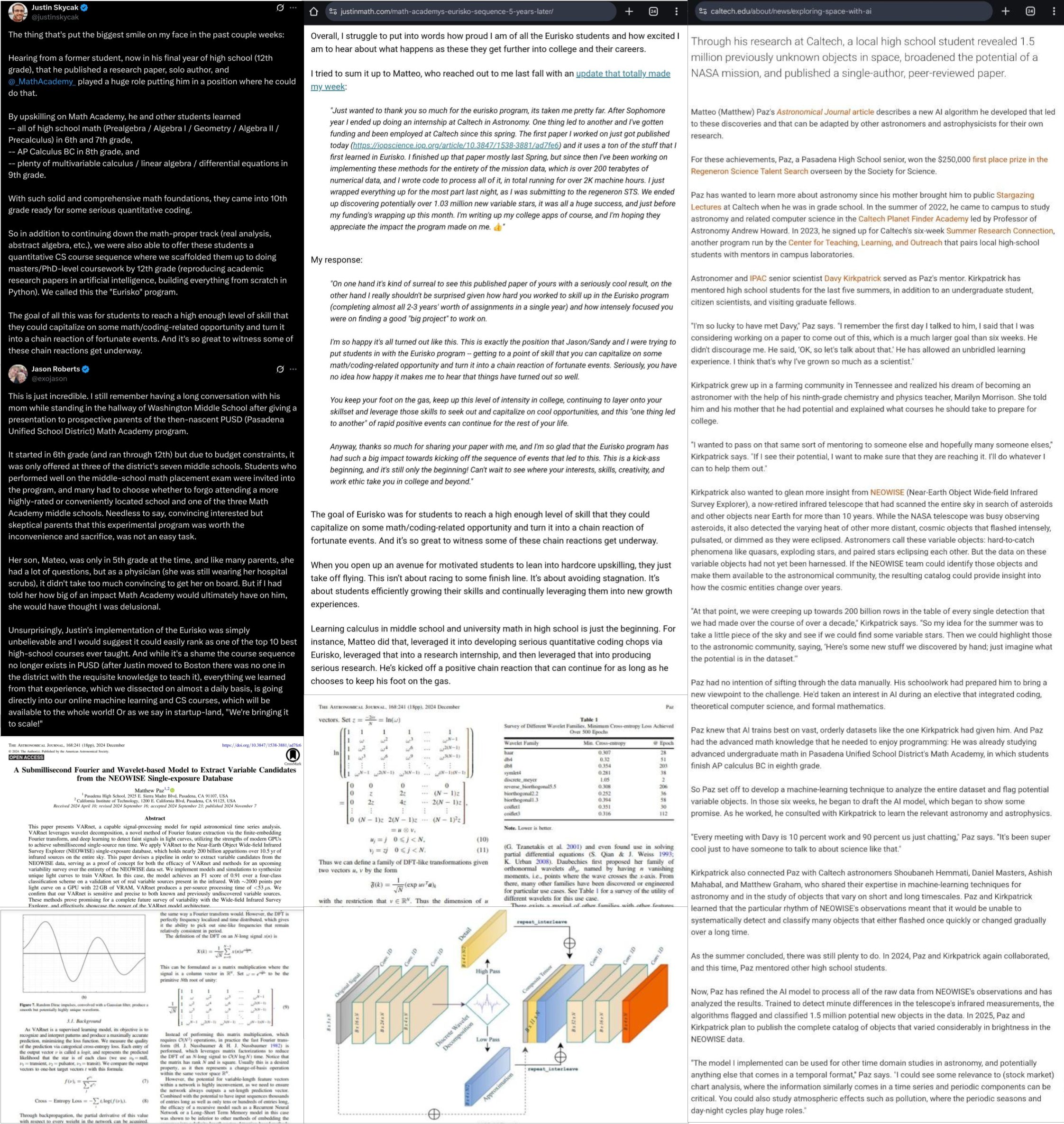
Then he participated in a research internship/mentorship program at Caltech, which was meant to be a brief 6-week taste of research, but he was skilled and driven enough to knock it out of the park, stay on afterwards, and achieve some serious results.
He leveraged his outsized math/coding chops to – as a high schooler – conduct research that “revealed 1.5 million previously unknown objects in space, broadened the potential of a NASA mission” (not hyperbole, a direct quote from Caltech’s website).
He also published his results solo-author in The Astronomical Journal and won 1st place ($250,000) in last year’s Regeneron Science Talent Search.
And now the head of NASA just asked him to apply, with a fighter jet ride as a signing bonus.
And this is still just the beginning – I can’t wait to see where his interests, skills, creativity, and work ethic take him in college and beyond.
Further reading:
- Math Academy’s Eurisko Sequence, 5 Years Later: Student Outcomes Emerging From the Most Advanced High School Math/CS Track in the USA
- What Happens When Middle School is Put to Good Use
- The (Free) Textbook I Wrote While Teaching The Most Advanced High School Math/CS Sequence In The USA
Want to get notified about new posts? Join the mailing list and follow on X/Twitter.